
1. Dubai Desert
  2. Dubai's desert reserves: DDCR, Al Marmoom, Al Qudra

Plan your trip

Dubai's desert reserves: DDCR, Al Marmoom, Al Qudra

DDCR ≈ 225 km² · Al Marmoom ≈ 949 km² · Arabian oryx, gazelles, lake birds

  • WhenCentre 09:00–17:00 daily
  • WhereDDCR · Al Marmoom · Al Qudra
  • Typical priceDDCR centre AED 35 adult

Compare and book

11 listings on Headout and GetYourGuide, prices refreshed daily.

Which one fits you

  • Wildlife at sunrise plus the lakes, on a modest budgetA sunrise jeep safari with Al Qudra Lakes
  • A quiet guided drive in the DDCR with time to lookA morning conservation drive with breakfast
  • Wildlife first, then dinner and culture at a heritage campA heritage evening safari in the DDCR or Al Marmoom
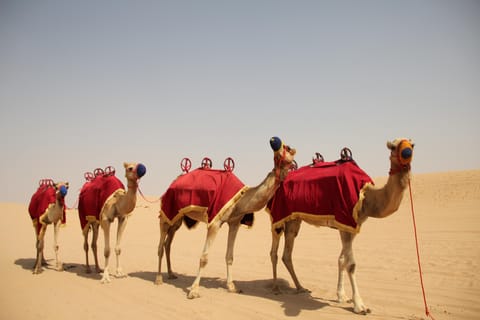
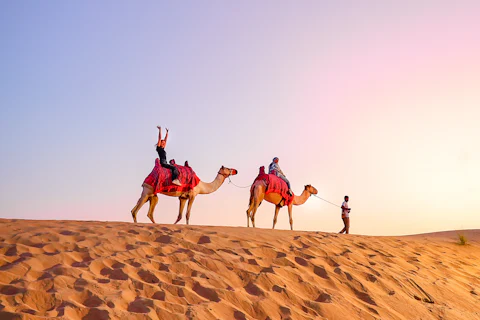
  • You want to ride a camel inside a reserveA heritage safari with a camel ride
  • Falcons are the main reason you goA private falconry morning in the DDCR
Time of day

Short answer

The Dubai Desert Conservation Reserve (DDCR) can be toured only with one of its approved operators, while Al Marmoom, which includes Al Qudra Lakes and the Al Qudra Cycle Track, is unfenced and open to the public. Both have free-roaming Arabian oryx and gazelles.

Official facts

From the official source, quoted word for word.

DDCR size
225 km², 4.7% of Dubai's land area, created in 2003.The Dubai Desert Conservation Reserve (DDCR), an area of 225 square kilometres, 4.7% of Dubai’s total land area, was created to protect the last remaining pristine desert landscape of this forward thinking emirate.ddcr.org · checked 12 November 2026
Oryx and gazelles in the DDCR
About 400 Arabian oryx, 300 Arabian gazelles and 100 sand gazelles.Starting with 70 Arabian oryx in 1999, there are 400 oryx currently on the reserve, the largest free-roaming herd of its kind in the UAE. In addition, there are approximately 300 Arabian Gazelles and 100 Sand Gazelles.ddcr.org · checked 12 November 2026
Who may drive in the DDCR
Only approved Dubai-based safari operators, on pre-planned routes.Only approved Dubai-based safari operators with qualified and registered guides are permitted to conduct four-wheel dune driving excursions and organise small dune dinner camps in these areas. Four-wheel excursions are restricted to pre-planned routes.ddcr.org · checked 12 November 2026
DDCR approved operators
The reserve names six approved tour operators for wildlife spotting.try wildlife spotting for real with one of the Reserve’s approved tour operators – Arabian Adventures, Sand Sherpa, Travco, 57 Heritage, Nara Desert Escapes, and Platinum Heritage.ddcr.org · checked 12 November 2026
DDCR Visitor's Centre hours
Open every day, 9:00–17:00.9AM-5PM, all daysddcr.org · checked 12 November 2026
DDCR Visitor's Centre fees
Walk-in fee AED 35 for adults, AED 25 for children.AED 35 for adultsddcr.org · checked 12 November 2026
Al Maha
The only resort with overnight stays inside the DDCR.The world renowned Al Maha Desert Resort & Spa is the only resort that offers visitors the opportunity to stay overnight within the Reserveddcr.org · checked 12 November 2026
Al Marmoom: size and access
Dubai's largest protected area, 949.35 km², unfenced and open to the public.The reserve is classified as a Category II (National Parks) Protected Area under the IUCN Protected Areas System, and is one of the first unfenced desert sanctuaries in the country open to the public for sustainable recreation.dm.gov.ae · checked 12 November 2026
Al Marmoom wildlife
Arabian oryx, sand gazelle and Arabian gazelle, plus many birds and reptiles.its delicate but persistent array of ecosystems support various wild animals like the Arabian Oryx, Sand Gazelle (Reem), and Arabian Gazelle (Aldmani) as well as an extraordinary diversity of bird, reptile and invertebrate species.dm.gov.ae · checked 12 November 2026
Bird hides and lakes in Al Marmoom
Eight bird hides; the lakes are open all year.Dubai Municipality has built eight bird hides at the reserve for bird watching to promote eco-tourism and provide Dubai residents with many opportunities to connect with nature.dm.gov.ae · checked 12 November 2026
Al Qudra Cycle Track
86 km of track through the desert.With 86km of track and amazing views of the desert, you might catch a glimpse of local wildlife– including the Arabian oryx.visitdubai.com · checked 12 November 2026

Two reserves, two ways in

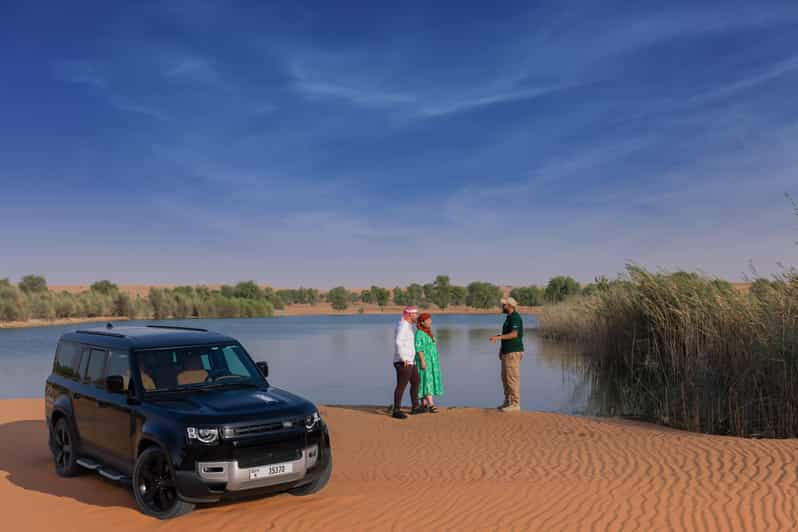
Dubai has two large desert reserves within reach of a half-day trip, and the rules for visiting them are opposite. In the Dubai Desert Conservation Reserve (DDCR), on the Al Ain road side, only approved operators may drive in the dunes, so you go in on their tours. Al Marmoom, on the Al Qudra side, is unfenced, and you can drive to its lakes and cycle track yourself.

Dubai Desert Conservation Reserve (DDCR) Al Marmoom Desert Conservation Reserve
Size ≈ 225 km², 4.7% of Dubai 949.35 km², Dubai's largest protected area
Run by A board backed by the Emirates Group Dubai Municipality
Access Approved operators only, on pre-planned routes; walk-in visitor centre Unfenced, open to the public
What you can do Wildlife drives, camel treks, horse riding, falconry, hot air balloon, dinner camps, archery Al Qudra Lakes, Love Lakes, 86 km cycle track, 8 bird hides, heritage camps, camel caravans
How to visit Book a tour with an approved operator Drive yourself, or book a sunrise or evening tour
Overnight Al Maha (guests only) and some operator camps Al Marmoom Domes glamping and heritage camps
Best for Seeing oryx up close with a guide Lakes, birds, cycling, a low-cost visit

Neither reserve is where the standard red-dune safaris go. Those run in Lahbab, Al Awir and Al Badayer; see what desert Dubai is in.

Dubai Desert Conservation Reserve

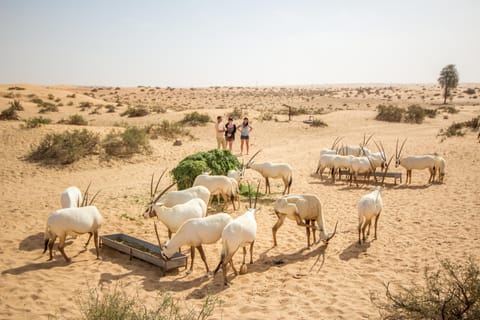
The DDCR grew out of a 27 km² reserve set up in 1999 around Al Maha, where 70 Arabian oryx were reintroduced. It became a formal reserve in 2003, and the DDCR calls itself the UAE's first national park. Today it counts about 400 oryx, 300 Arabian gazelles and 100 sand gazelles, plus foxes, hares, lizards and well over a hundred bird species.

The reserve is split into four zones. Researchers enter the wilderness zone on foot only; camel and horse rides happen in an ecotourism zone; and 4x4 drives and small dinner camps are allowed in a separate recreation zone, on fixed routes, by approved operators with registered guides. The reserve names Arabian Adventures, Sand Sherpa, Travco, 57 Heritage, Nara Desert Escapes (Sonara Camp) and Platinum Heritage, with Royal Shaheen for falconry.

What this means in practice: tours here are slower and quieter. Platinum Heritage, for example, runs wildlife drives in vintage or modern Land Rovers instead of dune bashing. Published prices by operators, checked November 2026: Platinum Heritage Heritage Desert Safari AED 795 per adult; its Conservation Drive with breakfast at Al Maha AED 2,400 per private vehicle. These are premium trips; see VIP and heritage safaris.

The DDCR Visitor's Centre is the one place you can walk in without a tour. It is open 9:00–17:00 every day, with walk-in fees of AED 35 for adults and AED 25 for children, and has exhibits on the reserve's animals and history and a viewing platform over the dunes.

Al Marmoom and Al Qudra Lakes

Al Marmoom covers almost 23% of Dubai, according to Dubai Municipality, and is classed as a national park under the IUCN system. It also contains the Mohammed Bin Rashid Solar Park and a houbara reintroduction programme. For visitors the focus is the Al Qudra side:

  • Al Qudra Lakes. A chain of man-made lakes. Visit Dubai counts 170 bird species there, and Swan, Flamingo and Duck Lakes are named after their visitors. The heart-shaped Love Lakes are nearby.
  • Al Qudra Cycle Track. 86 km of track through the desert. You can rent a bike at the Trek store at the end of Al Qudra Road. Plan your return: there are few taxis, and much of the track is not lit after dark.
  • Bird hides. Dubai Municipality has built eight in the reserve.
  • Heritage camps. Morning and evening tours with camel caravans, vintage cars, falcon shows and Bedouin-style meals; see camel rides and desert dinners.

Dubai Media Office puts Al Qudra Lakes about an hour's drive from Dubai International Airport.

Wildlife you can realistically see

Animal Where Notes
Arabian oryx DDCR, Al Marmoom, desert near Bab Al Shams Largest free-roaming herd in the UAE is in the DDCR; feeding stations near Bab Al Shams
Arabian and sand gazelles Both reserves ≈ 300 Arabian and 100 sand gazelles in the DDCR
Lake birds Al Qudra Lakes Swans, ducks and other migrants; flamingo numbers vary
Houbara bustard Near Al Qudra Lakes, DDCR Rare; both reserves have reintroduction work
Spiny-tailed lizard Both reserves Locally called dhub; can live up to 80 years

If flamingos are your goal, the surest place is in the city: Ras Al Khor Wildlife Sanctuary, where Visit Dubai says hundreds gather in the cooler months. For animals at dusk or by night, compare stargazing and night drives.

Tips for a wildlife trip

  • Go early if you can. Sunrise and morning drives are cooler; see morning safaris.
  • Check whether the trip enters the DDCR or Al Marmoom, and which one: they are different experiences.
  • Bring binoculars and a long lens if you have one. Do not ask the driver to leave the track; in the DDCR, routes are fixed.
  • In Al Marmoom, stay on paved roads unless you have a 4x4 and experience of driving on sand.
Questions people ask

Can you visit the Dubai Desert Conservation Reserve on your own?
Not for driving in the dunes: only approved operators with registered guides may run drives and camps there. You can walk in to the DDCR Visitor's Centre (AED 35 adults, AED 25 children, 9:00–17:00 daily).
Which companies can take you into the DDCR?
The reserve lists Arabian Adventures, Sand Sherpa, Travco, 57 Heritage, Nara Desert Escapes and Platinum Heritage as approved operators, with Royal Shaheen for falconry. Al Maha arranges activities for its own guests.
Where can I see Arabian oryx near Dubai?
In the DDCR, which has about 400 free-roaming oryx, and in Al Marmoom. Visit Dubai also notes feeding stations in the desert near Bab Al Shams where sightings are common.
Is Al Qudra Lakes free to visit?
Al Marmoom is unfenced and open to the public, and Dubai Municipality says families can visit the lakes all year. Dubai Municipality's page mentions no entry fee; tours to the lakes are paid.
Where are the flamingos?
Flamingo Lake is one of the Al Qudra lakes, but numbers vary. In the city, Ras Al Khor Wildlife Sanctuary hosts hundreds of flamingos in the cooler months.
Is there dune bashing in the reserves?
In the DDCR, 4x4 driving is limited to pre-planned routes by approved operators, and some of them run gentle wildlife drives instead of dune bashing. For full dune bashing, see the Lahbab and Al Awir safaris.
Can you stay overnight inside the DDCR?
Al Maha is the only resort inside the reserve and is for its guests only. Some approved operators also run overnight stays at their camps.

Read next

Sources

  1. ddcr.org — DDCR size
  2. ddcr.org — DDCR approved operators
  3. ddcr.org — Al Maha
  4. dm.gov.ae — Al Marmoom: size and access
  5. visitdubai.com — Al Qudra Cycle Track
  6. ddcr.org — UAE's first national park; species descriptions
  7. visitdubai.com — Oryx, gazelles, houbara, Al Qudra lake birds, spiny-tailed lizard
  8. visitdubai.com — Oryx recovery; flamingos at Ras Al Khor
  9. mediaoffice.ae — Love Lakes, Flamingo Lake; DDCR visits through tour companies

Prices, ratings and durations: GetYourGuide, refreshed daily.